What Each One Is
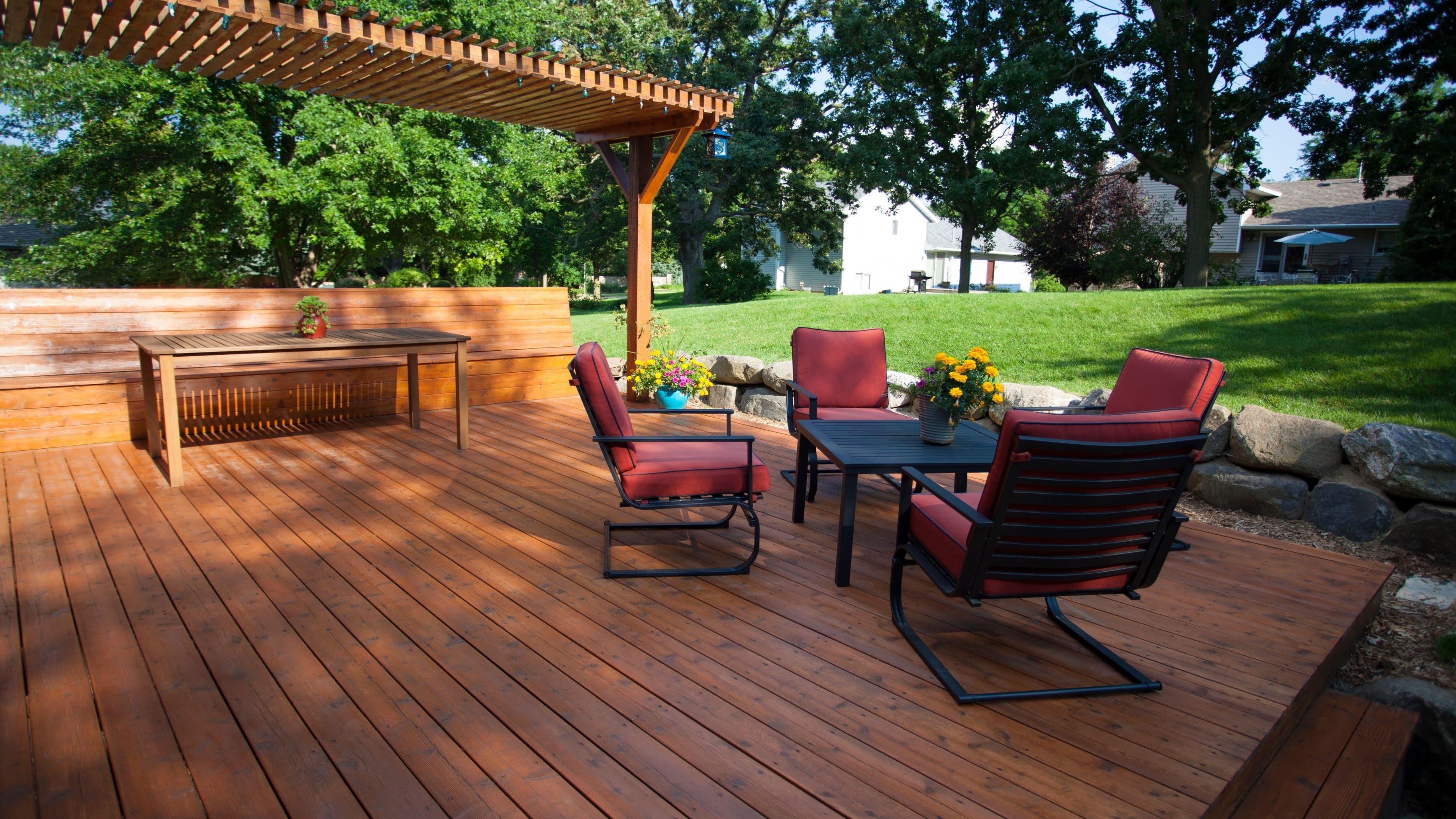
A deck is an elevated platform, typically constructed from wood or composite lumber, that attaches to the house and is supported by posts and footings. It's usually accessed directly from the home through a sliding or French door and sits above ground level – sometimes a few inches, sometimes several feet, depending on your home's foundation and grade.
A patio is a ground-level hard surface installed directly on or slightly above the ground. It's constructed from concrete, pavers, natural stone, brick, or stamped concrete, and it doesn't require the structural framing that a deck does. Patios can be attached to the house or freestanding further in the yard.
The distinction matters practically because each solution has fundamentally different construction requirements, cost profiles, and maintenance demands – which in turn affects which is the better investment for your specific situation.
Cost Comparison
Cost is typically the first variable to compare, and both projects cover a wide range depending on size, materials, and complexity.
Decks run approximately $15–$35 per square foot for pressure-treated wood construction, and $25–$60 per square foot for composite decking materials (like Trex or TimberTech). A modest 300 sq ft deck in pressure-treated wood might cost $5,000–$10,000 installed. The same deck in composite material runs $8,000–$18,000. Multi-level decks, wraparound designs, or decks over 10 feet off the ground add significantly to cost due to additional structural requirements, railings, and stairs.
Patios generally run $8–$20 per square foot for concrete or basic pavers, and $15–$40 per square foot for natural stone, slate, or premium paver systems. A 300 sq ft concrete patio lands in the $2,400–$6,000 range. A premium flagstone or travertine patio of the same size can push $6,000–$12,000. Patios in flat, accessible backyards at simpler designs tend to come in meaningfully below deck equivalents of the same size.
Bottom line on cost: Patios are generally less expensive to install than decks of equivalent size, especially at the entry level. The gap narrows as you move to premium patio materials and widens again when deck complexity increases.
Return on Investment
This is where the data gets nuanced. Remodeling Magazine's annual Cost vs. Value report tracks renovation ROI nationally and finds that wood decks typically recoup around 50–65% of their cost at resale, while composite decks recover 50–60%. These figures vary by region – in markets where outdoor living is a significant selling point (the Southeast, Pacific Northwest, parts of the Southwest), returns are meaningfully higher than in colder northern markets where outdoor season is short.
Patios don't have their own dedicated line in Cost vs. Value reporting because they're typically bundled into broader landscaping and outdoor improvement categories. Industry estimates generally put patio ROI in the 50–80% range, with the higher end applying to well-executed paver or natural stone patios in strong outdoor-living markets. The argument for patios from an ROI standpoint is that their lower installation cost means the absolute dollars recouped at sale can approach or exceed what you'd recover on a more expensive deck.
The honest framing is that neither project is a guaranteed positive ROI investment, and both will recoup a larger share of cost in markets and climates where outdoor living space is a meaningful selling point. If you're in a market where buyers actively look for outdoor entertaining areas and you don't have one, adding either a deck or a patio addresses a genuine gap in your home's appeal. If you're in a climate where outdoor season is limited, the value case is softer.
Durability and Maintenance
This comparison shifts the calculus significantly depending on your tolerance for ongoing maintenance.
Wood decks require consistent upkeep to stay in good condition. Pressure-treated lumber should be cleaned and resealed or stained every 1–3 years. Without it, wood weathers, grays, cracks, and eventually rots. Even with good maintenance, the structural elements of a wood deck have a functional lifespan of 15–20 years before significant repair or replacement work is needed. The maintenance commitment is real and the cost isn't zero – professional deck refinishing runs $500–$1,500 depending on size.
Composite decks address the maintenance problem significantly. Composite boards don't need sealing or staining and resist moisture and UV degradation better than wood. They're more expensive upfront but carry warranties of 25–50 years on the boards themselves, and the ongoing maintenance cost drops to periodic cleaning. The trade-off is that composite can't be refinished if scratched or damaged the way wood can – damaged boards need replacement.
Patios generally require the least ongoing maintenance of the three. Concrete is durable and low-maintenance beyond occasional cleaning and resealing every few years. Paver patios may require occasional re-leveling if individual pavers shift, and weeds can grow in the joints without polymeric sand or regular attention. Natural stone patios are durable and long-lasting with minimal care. Most patios, if well-installed with proper drainage and base prep, will outlast a wood deck with less total effort and cost over the same period.
Bottom line on maintenance: Patios and composite decks win on long-term maintenance cost and effort. Wood decks carry the highest ongoing maintenance commitment of any outdoor surface option.
Which Works Best for Different Yard Types
Your yard's specific conditions often determine which option is actually feasible, not just which you prefer.
Elevated home or significant grade change: If your home sits on a foundation that's 3–8 feet above ground level, a deck is often the natural solution because it extends directly from an interior door at the right height. Installing a patio in this scenario requires significant regrading or a long staircase descent from the door – neither of which is ideal. Decks handle grade transitions naturally.
Flat yard at ground level: When your home's door opens nearly at ground level and your yard is relatively flat, a patio is simpler, less expensive, and structurally straightforward. You don't need the engineering and structural framing that elevates a deck – you can pour a slab or lay pavers and be done.
Sloped yard: Both options are viable on sloped yards, but patios require retaining walls or terrace construction to create a flat usable surface. Decks can be built over a sloped yard with varying post heights and create level usable space above the slope without terraforming. This can make a deck more cost-effective on a significantly sloped lot than building and retaining a flat patio area.
Small urban backyard: Patios typically work better in tight urban backyards where construction access is limited and material delivery is constrained. Hauling framing lumber, joist hangers, and structural posts through a narrow gate or house access is harder than delivering paver pallets. For small lots, patios are often the more practical build.
Permits and Code Considerations
Both decks and patios typically require permits in most jurisdictions, though decks are more likely to trigger additional requirements. An elevated deck attached to the home is a structural addition that requires a permit and inspection in virtually every US municipality. Code requirements cover footing depth, post sizing, joist spacing, railing height and strength, and ledger attachment to the house.
Patios at grade often have simpler permitting requirements, and some municipalities don't require permits for ground-level paver patios below a certain size. This can make patios faster to get approved and started, particularly in jurisdictions with slower permit processing.
If your property is in an HOA community, both projects require HOA approval before permits are pulled. Check your HOA's architectural guidelines first, as some have material or size restrictions for outdoor structures.
Which Option Is Right for You
The decision usually comes down to three questions.
What does your home's grade require? If your back door is elevated significantly above the yard, a deck is the natural and often only practical option. If your door opens nearly at grade, a patio is the simpler choice.
What's your maintenance tolerance? If you want a set-it-and-largely-forget-it outdoor surface, a paver or concrete patio (or a composite deck) will serve you better than a wood deck that needs annual or biennial attention. If you enjoy the look of natural wood and don't mind maintaining it, a wood deck can look excellent for many years with proper care.
What does your market value? In warm climates and outdoor-living-centric markets, a well-built deck or premium patio is a genuine selling asset. In shorter-season northern markets, the ROI case is softer and personal enjoyment value should factor more heavily into the decision than resale calculation.
For most homeowners with a flat or gently sloped yard where the door is near grade, a well-executed paver patio offers the better combination of cost, durability, low maintenance, and solid resale contribution. For homes with elevation or significant grade change, a composite deck is worth the higher upfront investment for the longevity and reduced maintenance commitment over wood.
What to Avoid
Undersizing for how you'll actually use the space. A 10x10 deck or patio sounds adequate until you're trying to fit a table, four chairs, and a grill on it. Build for your actual use case. For a dining setup plus lounge area, 300–400 square feet is a more realistic minimum.
Using untreated or improper lumber on a wood deck. Ground contact and structural members require pressure-treated lumber rated for ground contact. Using the wrong grade of wood in structural applications is a code violation and a durability problem.
Skimping on patio base prep. A paver patio installed without proper compacted gravel base and sand setting bed will heave, shift, and look deteriorated within a few years. The quality of the base is more important than the quality of the paver material on top of it.
Ignoring drainage. Both decks and patios need to be designed with drainage in mind. Water that pools against the house from an improperly sloped patio causes foundation and moisture problems that are expensive to fix. Decks need drainage that doesn't trap moisture against the ledger board or house.
FAQ
Does a deck or patio add more value to a home? It depends on market and execution. Decks tend to have more dedicated resale data showing 50–65% cost recovery. Patios at lower cost can recover a comparable percentage while requiring less total outlay. In strong outdoor-living markets, a well-built version of either adds meaningful value. Neither is a guaranteed positive return on cost.
How long does each take to build? A straightforward deck or patio at 300–400 sq ft typically takes a professional crew 3–7 days to complete. Larger or more complex projects extend to 2–3 weeks. Permitting time adds to the overall timeline – plan for 2–8 weeks for permit approval depending on your municipality.
Can I DIY a patio or deck? A basic paver patio is one of the more accessible large DIY projects for a homeowner comfortable with physical work and willing to learn proper base preparation. A deck is more technically demanding due to structural requirements, footing work, and code compliance – achievable for skilled DIYers but not a beginner project. Either way, permitted work requires inspection regardless of who builds it.
What size deck or patio should I build? A practical outdoor living space starts at around 200–250 sq ft for a basic setup. For a dining area plus a separate lounge or cooking zone, 350–500 sq ft gives you room to use the space without it feeling cramped. Bigger is generally better for resale, up to the point where it dominates the yard and limits lawn or garden space.
Wood or composite deck – which is better? Composite wins on durability and maintenance over a 20-year horizon despite the higher upfront cost. Wood wins on initial cost and is repairable and refinishable in a way composite is not. If you're budgeting carefully and willing to maintain it, wood is viable. If you want to minimize ongoing cost and effort, composite is the better long-term investment.
📚 Sources
Remodeling Magazine – 2024 Cost vs. Value Report – https://www.remodeling.hw.net/cost-vs-value/2024/
HomeAdvisor – Average Cost to Build a Deck – https://www.homeadvisor.com/cost/outdoor-living/build-a-deck/
HomeAdvisor – Average Cost to Install a Patio – https://www.homeadvisor.com/cost/patios-and-porches/install-a-patio/
National Association of Realtors – Remodeling Impact Report – https://www.nar.realtor/sites/default/files/documents/2022-remodeling-impact-report-04-19-2022.pdf
This Old House – How to Build a Deck – https://www.thisoldhouse.com/decks/21014896/how-to-build-a-deck
Bob Vila – Patio vs. Deck: Which Is Right for Your Backyard? – https://www.bobvila.com/articles/patio-vs-deck/
🔍 Explore Related Topics


-jhajrFUGfI3zCQGjpAWcxuNPi1zUTB.jpg&w=3840&q=75)